
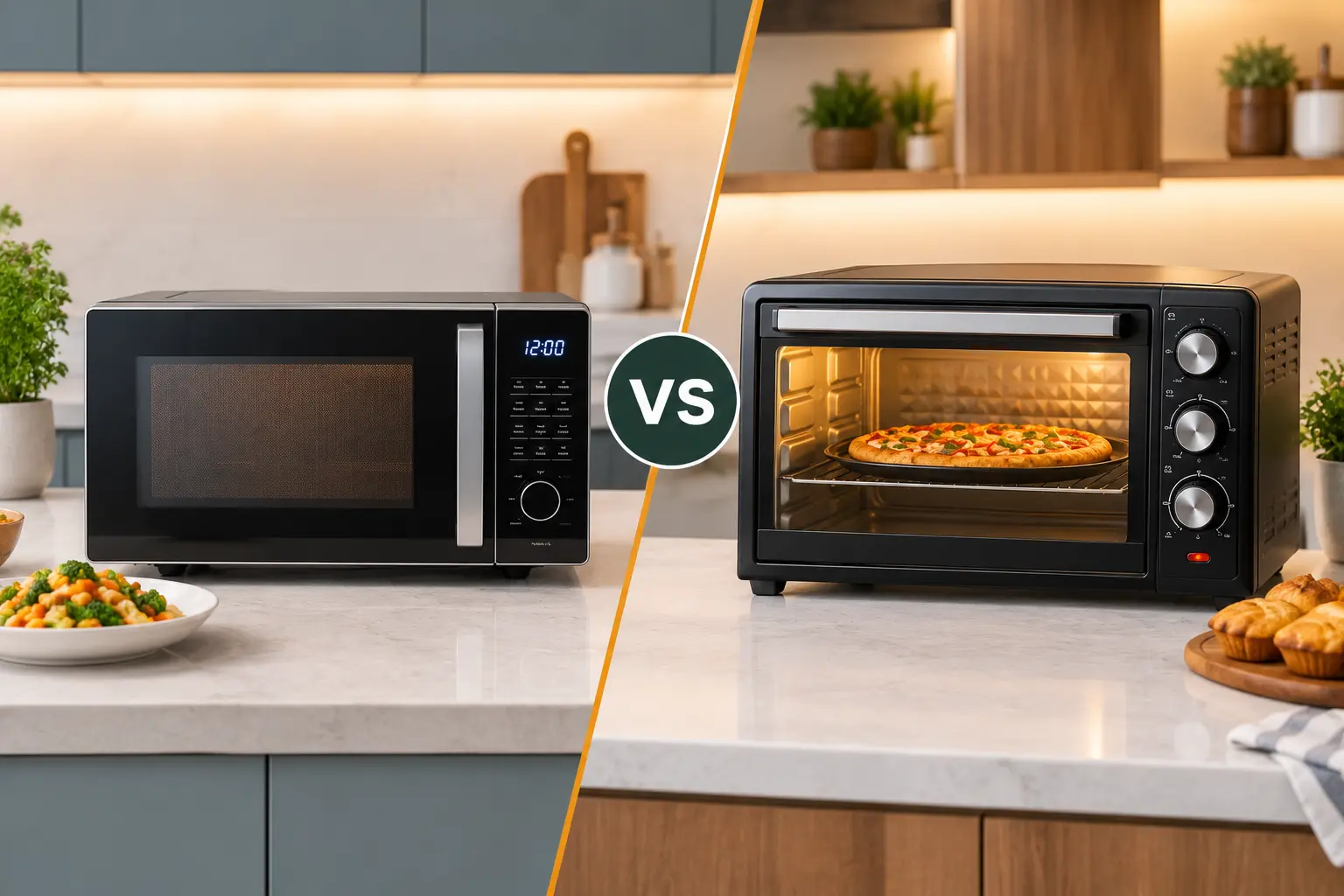
Microwave vs. OTG: Which Should You Buy for Your Kitchen
Walk into any home appliance store today, and you'll find yourself standing between two boxes that promise to transform your cooking — the microwave and the OTG (Oven Toaster Griller). Both look similar from the outside, both claim to make your kitchen life easier, yet they work in completely different ways.
Most of us already know the basics — microwaves reheat fast, OTGs bake well. But when it's time to actually spend money on one, the real questions pop up: which one suits your cooking style, which one saves more electricity, and which one will you actually use daily? This guide skips the obvious stuff and focuses on what really helps you decide.
What Is the Difference Between a Microwave and an OTG?
A microwave uses electromagnetic waves to heat water molecules inside food, which is why it's so fast for reheating and defrosting. An OTG uses heating coils at the top and bottom to circulate hot air, cooking food evenly — which is why it's the go-to choice for baking.
|
Feature |
Microwave |
OTG |
|
Cooking Technology |
Electromagnetic radiation |
Heating coils (top & bottom) |
|
Best Use |
Reheating, defrosting, quick cooking |
Baking, grilling, roasting |
|
Cooking Time |
Faster |
Slower but more even |
|
Texture Results |
Good for everyday meals |
Superior for baked goods |
|
Price Range |
Slightly higher (convection models) |
Generally more budget-friendly |
|
Space Required |
Compact |
Slightly bulkier |
What Do Most People Get Wrong About Microwaves and OTGs?
1. "Convection Microwave = OTG" — Not Quite
A convection microwave uses a fan to circulate hot air alongside microwave radiation, cooking faster but rarely matching the crisp, evenly-browned crust an OTG's direct heating coils produce. For serious bakers, OTG still wins on texture.
2. Preheating Isn't Always Necessary
Solo and grill microwaves don't need preheating at all — skipping this step saves electricity and time. OTGs, however, genuinely need 8-10 minutes of preheating for accurate baking, especially for cakes.
3. Metal Isn't Always Banned
It's common knowledge that metal can't go into a microwave — but some microwave grill models come with a metal rack specifically designed for use inside. Always check your manual rather than assuming.
4. OTGs Often Consume Less Power
Despite looking bulkier, a standard OTG (600-800 watts) frequently uses less electricity per task than a convection microwave (1200-1500 watts), since OTGs don't need to power a rotating turntable or additional fan systems.
5. Litre Capacity Can Be Misleading
A 20L microwave and a 20L OTG won't fit the same size dish. OTGs usually offer more usable vertical space for baking trays, while microwaves lose room to the turntable. Check internal cavity dimensions, not just litre capacity, if you bake in large tins.
Who Should Buy a Microwave?
- Working professionals or small families needing quick meal solutions
- Households where reheating and defrosting are the primary need
- Buyers wanting a convection model that can occasionally handle light baking
- Limited kitchen space requiring a compact, multi-purpose appliance
Who Should Buy an OTG?
- Households where baking is a regular activity — cakes, cookies, pizzas
- Buyers who prefer a crisp, oven-baked texture over steamed results
- Those comfortable with slightly longer cooking times for better results
- Budget-conscious buyers who still want reliable baking and grilling
How Do You Maintain a Microwave and OTG for a Longer Lifespan?
- Microwave: Wipe the interior with a damp cloth after every use to stop food splatters from carbonizing on the walls, which affects heating efficiency over time. Avoid running it empty except during manual-specified preheat cycles.
- OTG: Clean the crumb tray regularly to prevent smoke and burnt smells. Check the door seal periodically — a loose seal lets heat escape and increases cooking time.
What Safety Precautions Should You Follow?
Not all plastic containers are microwave-safe, even if they look similar. Look for the "microwave-safe" symbol (wavy lines inside a square) — the wrong container can leach chemicals into food or melt under heat. For OTGs, always use metal, glass, or ceramic bakeware rated for oven temperatures above 200°C.
Can You Buy Both a Microwave and an OTG?
Many modern Indian kitchens now keep both — a solo or grill microwave for daily reheating, and a separate OTG dedicated to baking and grilling. If your budget and counter space allow it, this combination covers every cooking need without compromise.
What Should You Consider Before Buying?
- Cooking habits – Frequent baker or mostly quick reheating?
- Family size – Larger families may need higher-capacity appliances
- Kitchen space – Measure your counter space beforehand
- Budget – OTGs are generally more affordable; convection microwaves cost more but add versatility
- Brand and warranty – Buy from a trusted seller offering genuine products and reliable support
Where Can You Buy the Best Microwave or OTG in Mancherial?
As the best electronics shop in Mancherial, Yashaswi Electronics offers a wide range of microwaves and OTGs from India's leading brands, backed by genuine manufacturer warranty and honest, needs-based guidance — not upselling.
As a trusted electronics retail store in Mancherial, our team takes the time to understand your actual cooking habits before recommending an appliance. Browse our range of home and kitchen appliances in Mancherial, or visit us in-store to compare models hands-on.
Whether you need a compact solo microwave, a feature-rich convection model, or a dependable OTG for weekend baking, you'll find it all at Yashaswi Electronics — recognized as one of the best electronics appliances stores in Mancherial.
Conclusion: Microwave or OTG — Which One Should You Choose?
There's no universal winner between a microwave and an OTG — it depends on how you cook. Prioritize speed and convenience? Go with a microwave. Want that classic oven-baked crispness? An OTG is the clear choice.
Still unsure which one fits your kitchen? Visit Yashaswi Electronics today, and let our team help you find the perfect appliance for your home.
Frequently Asked Questions (FAQs)
Q1. Can an OTG replace a microwave?
Not entirely. An OTG is excellent for baking, grilling, and roasting, but it can't reheat food as quickly or efficiently as a microwave. If fast reheating is a daily need, a microwave is still more practical.
Q2. Can a microwave replace an OTG for baking?
A convection microwave can bake reasonably well and works fine for everyday cakes and cookies. However, for professional-level baking with a crisp, evenly browned crust, an OTG generally gives better results.
Q3. Which is cheaper, a microwave or an OTG?
OTGs are usually more affordable than microwaves, especially compared to convection models. Basic solo microwaves can be competitively priced, but once you move to grill or convection variants, OTGs tend to cost less for similar capacity.
Q4. Which consumes more electricity, a microwave or an OTG?
It depends on usage and wattage. A convection microwave typically uses more power (1200-1500 watts) than a standard OTG (600-800 watts), but microwaves usually complete cooking faster, which can balance out overall electricity consumption.
Q5. Is OTG good for daily use?
Yes, an OTG is suitable for daily use, especially for baking, grilling, and toasting. However, it's not the best choice for quick reheating tasks, where a microwave is faster and more convenient.
Q6. Which is better for a small kitchen, a microwave or an OTG?
Microwaves are generally more compact and better suited for small kitchens with limited counter space. OTGs tend to be bulkier, though compact OTG models are also available for smaller households.